
Sustainability Management
From PLUS no kokoro to sustainability management
We believe that, for the PLUS Group, sustainability means realizing our philosophy “Unique Values ‑ Higher Satisfaction” as defined in PLUS no kokoro, and contributing to the resolution of social issues via our business activities.
The PLUS Group Sustainability Policy, key action themes, and materiality were established so that we could clearly communicate our stance towards sustainability and action guidelines to our various stakeholders.
Sustainability Policy

The PLUS Group will continue striving to solve social issues with unique and totally original ideas, and to provide new value and new satisfaction for all, from offices to schools and homes, from children to adults. We will contribute to a sustainable future by growing along with people and society, aiming to achieve Social Optimality in harmony with the environment.

Corporate Philosophy and Sustainability Policy
PLUS no kokoro is composed of Our Philosophy, Our Vision, Our Values, and Our Guidelines for Actions. We believe that, for the PLUS Group, sustainability means realizing our philosophy “Unique Values - Higher Satisfaction” as defined in PLUS no kokoro, and contributing to the resolution of social issues via our business activities. The PLUS Group Sustainability Policy, key action themes, and materiality were established so that we could communicate clearly our stance towards sustainability and action guidelines to our various stakeholders.
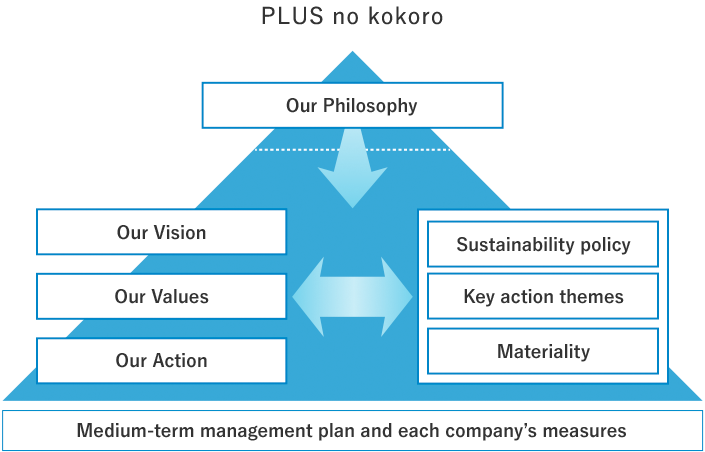
Sustainability Policy System
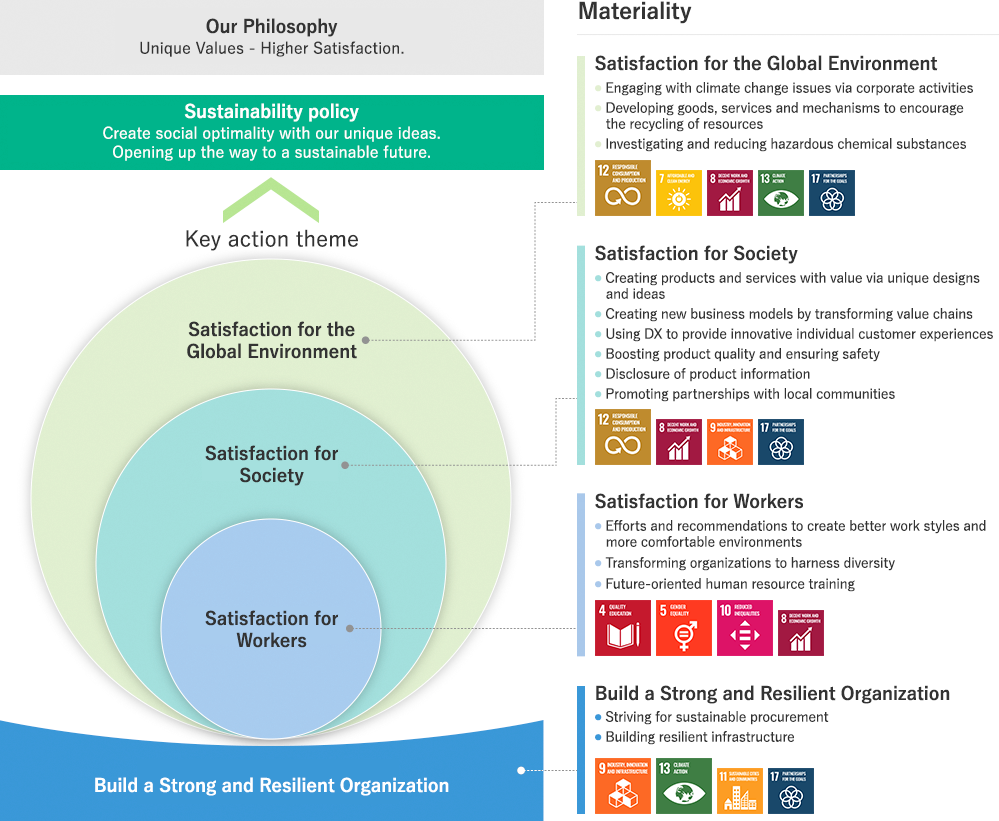
Organizational Structure for Sustainability of the PLUS Group
The Sustainability activities of the PLUS Group are carried out with the senior managing director of PLUS Corporation in charge under the supervision of the Group Management Meeting, Meeting of Board Directors, and the Corporate Council to work on issues in cooperation with the Sustainability Office of the corporate headquarters and the Risk Management Committee of PLUS Corporation.
At overseas bases, the Compliance Committee and the Sustainability Office hold seminars on compliance, Sustainability, and SDGs for local employees using the online meeting system, to promote awareness of basic concepts and direction of the Group’s Sustainability throughout the Group as well as issues to be addressed in the future by exchanging and sharing information.
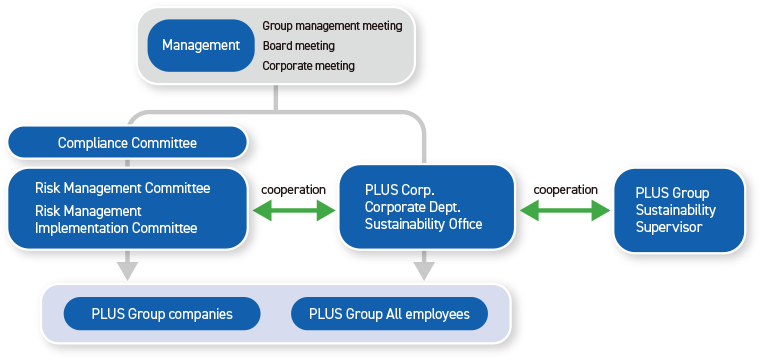
Promoting Sustainability Through Internal Education and Employee Training
The PLUS Group is committed to promoting sustainability throughout the Group through sustainability-related education and training. To ensure that every employee understands stakeholder expectations and the role we are expected to play, we provide annual e-learning programs that empower employees to become active drivers of sustainability initiatives.
To evaluate the effectiveness of these educational and training programs, we have conducted an annual Sustainability Awareness Survey for all employees since 2023. The FY2025 survey found that 98% of employees have an interest in sustainability.
Education and training on sustainability in fiscal year 2025 (partial extract)
- New Employee Onboarding Program
- E‑learning Program for All PLUS Group Employees
- SDGs Workshop
- Micro‑Learning Video Series: “Sustainability in Almost 3 Minutes!” (7 Sessions)
| Period | Number of Sessions of Education/Training |
|---|---|
| January to December, 2022 | 5 times |
| January to December, 2023 | 4 times |
| January to December, 2024 | 7 times |
| January to December, 2025 | 13 times |
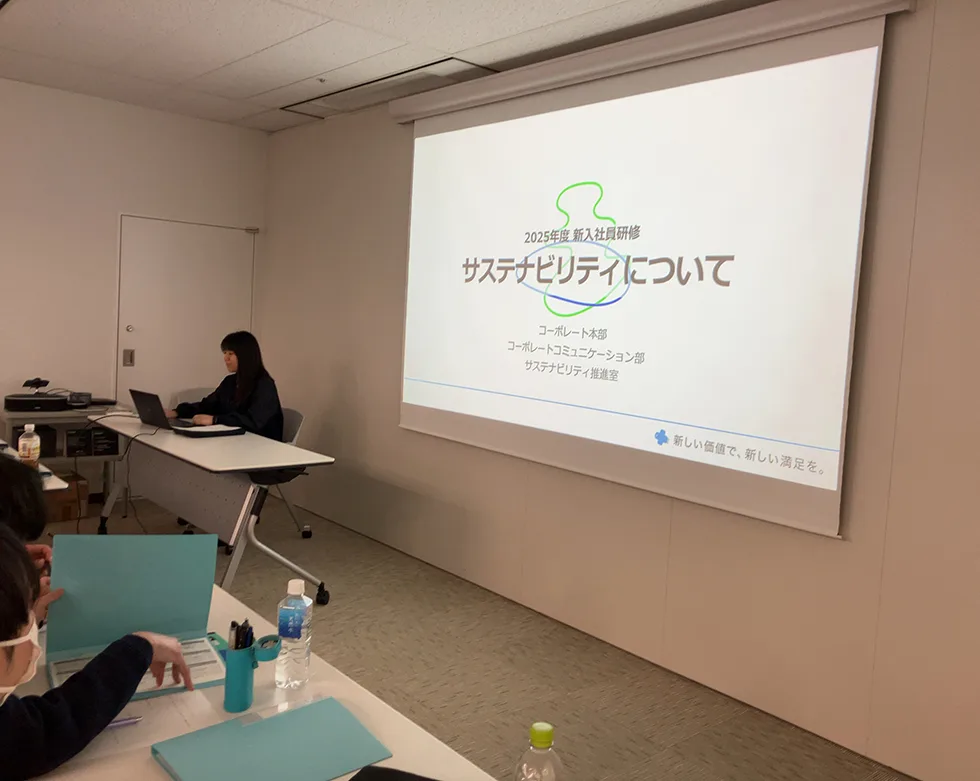
PLUS Group's Materialities
Since 2021, the PLUS Group has held working Group with sustainability representatives from each Group company to identify and examine key sustainability issues. In 2022, based on its Sustainability Policy, the Group assessed the importance of social issues and their impact on the Group's business activities, and established four priority themes and 14 materiality issues.
Based on these materiality issues, the Group strives to help solve social challenges through its business activities and create sustainable corporate value.
Going forward, the Group will continue to define the direction of its initiatives and set targets, taking into account stakeholder expectations and changes in the social environment, while continuously reviewing its efforts and contributing to the realization of a sustainable society.
Key Action Themes for Sustainability
Satisfaction for Workers

People can't enjoy their jobs and work towards a sustainable future unless they have a work environment that everyone finds fun and exciting. We create the ideal environment for a diversity of people, with diverse work styles, to thrive and shine, giving workers a sense of fulfillment and satisfaction.
Satisfaction for Society

We will review the current situation in totally new ways, and create products, services and systems that are more convenient, comfortable and environmentally friendly than ever before. We will deliver peace of mind, safety, excitement and satisfaction to all members of society and enrich their daily lives.
Satisfaction for the Global Environment

Via resource recycling initiatives that use limited resources and energy without wasting them, we will take on climate change and other challenges confronting a sustainable society, and strive to create a resilient society that preserves the beautiful global environment.
Build a Strong and Resilient Organization

We strive to build sustainable organizations that have the resilience to deal with new environments, changes, and diverse situations.
Key Action Themes and Materialities
The following outlines the Group's key action themes, materiality, and corresponding initiative themes. KPIs have been established for each materiality item to monitor progress.
| Key Action Theme | Materiality | Theme | Social Issues to Be Tackled | Related SDGs |
|---|---|---|---|---|
| Satisfaction for Workers | Efforts and recommendations to create better work styles and more comfortable environments |
|
|
|
| Transforming organizations to harness diversity |
|
|||
| Future‑oriented human resource training |
|
|||
| Satisfaction for Society | Creating products and services with value via unique designs and ideas |
|
|
|
| Creating new business models by transforming value chains |
|
|||
| Using DX to provide innovative individual customer experiences |
|
|||
| Boosting product quality and ensuring safety |
|
|||
| Disclosure of product information |
|
|||
| Promoting partnerships with local communities |
|
|||
| Satisfaction for the Global Environment | Engaging with climate change issues via corporate activities |
|
|
|
| Developing goods, services and mechanisms to encourage the recycling of resources |
|
|||
| Investigating and reducing hazardous chemical substances |
|
| Build a Strong and Resilient Organization | |||
| Materiality | Theme | Social Issues to Be Tackled | Related SDGs |
|---|---|---|---|
| Striving for sustainable procurement |
|
|
|
| Building resilient infrastructure |
|
||
Materiality and SDGs
We have verified and clarified the relationship between each of our 14 materialities and the 17 goals and 169 items targeted in the SDGs (Sustainable Development Goals) adopted by the United Nations in 2015. The PLUS Group tackles a wide range of issues to do with the environment, society and the economy, and is contributing to the achievement of the SDGs.
1 |
2 |
3 |
4 |
5 |
6 |
7 |
8 |
9 |
10 |
11 |
12 |
13 |
14 |
15 |
16 |
17 |
|
| Satisfaction for Workers | |||||||||||||||||
| Efforts and recommendations to create better work styles and more comfortable environments | ● | ● | ● | ● | |||||||||||||
| Transforming organizations to harness diversity | ● | ● | ● | ● | |||||||||||||
| Future‑oriented human resource training | ● | ● | ● | ● | |||||||||||||
| Satisfaction for Society | |||||||||||||||||
| Creating products and services with value via unique designs and ideas | ● | ● | ● | ||||||||||||||
| Creating new business models by transforming value chains | ● | ● | ● | ● | |||||||||||||
| Using DX to provide innovative individual customer experiences | ● | ● | ● | ● | |||||||||||||
| Boosting product quality and ensuring safety | ● | ● | ● | ||||||||||||||
| Disclosure of product information | ● | ● | |||||||||||||||
| Promoting partnerships with local communities | ● | ● | ● | ||||||||||||||
| Satisfaction for the Global Environment | |||||||||||||||||
| Engaging with climate change issues via corporate activities | ● | ● | ● | ● | ● | ● | |||||||||||
| Developing goods, services and mechanisms to encourage the recycling of resources | ● | ● | ● | ● | ● | ● | ● | ● | |||||||||
| Investigating and reducing hazardous chemical substances | ● | ● | |||||||||||||||
| Build a Strong and Resilient Organization | |||||||||||||||||
| Striving for sustainable procurement | ● | ● | ● | ● | ● | ● | ● | ● | |||||||||
| Building resilient infrastructure | ● | ● | ● | ||||||||||||||
| 1 |
2 |
3 |
4 |
5 |
6 |
7 |
8 |
9 |
10 |
11 |
12 |
13 |
14 |
15 |
16 |
17 |
|
The Materiality Identification and Management Process
To ensure comprehensiveness, objectivity, and uniqueness, we identified materiality using the following three steps in 2022. Materiality is reviewed and discussed annually in accordance with the three-year Medium-term Business Plan, taking into account such matters as changes in the importance of issues and the emergence of new issues and is revised as necessary.
STEP1Select social issues
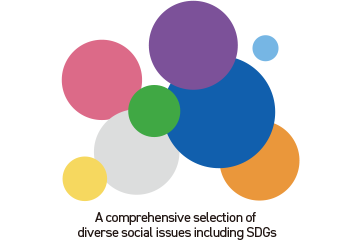
We started by considering 205 social issues
When discussing materiality, we first selected a wide range of sustainability issues on the basis of international initiatives, industry policies, and stakeholder surveys. We created a list of 205 issues. Furthermore, we added information about the company, such as the Medium‑term Business Plan, employee satisfaction surveys, and top messages sent internally and externally, to the 205 issues and made a selection.
Reference materials used when selecting issues
- Initiatives referenced: ISO 26000, OECD Guidelines for Multinational Enterprises, SDGs, etc.
- Industry policies referenced: All Japan Stationery Association, Japan Office Institutional Furniture Association
- Stakeholder surveys: Survey items from customer companies, employee engagement surveys
STEP2Rank in priority for the PLUS Group
We discussed which were issues where the PLUS Group could make a contribution
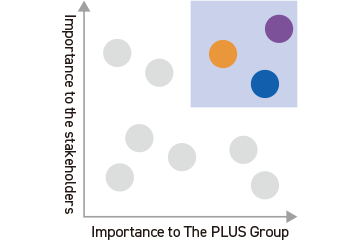
We created a working Group that cuts across our four business companies and nine Group companies (as of 2021), and held several workshops. From among the issues listed, ones that are particularly relevant to the business of the PLUS Group were selected, and each issue was organized into “aggressive” (issues that lead to business opportunities for the company) and “defensive” (issues that might lead to risks for the company). These were quantitatively evaluated and weighted on the two axes of “importance to the PLUS Group” and “importance to stakeholders”.
In addition, based on the degree of relevance to the business strategies of each company and our vision of their future, we discussed important issues while taking into consideration such questions as, “To which issues can we contribute in a more typically PLUS Group way?” and “Which issues will lead to future growth?” For the assessments of critical issues, we adopted an objective approach while referencing the opinions of outside experts.
STEP3Management approval
Materiality approved by the Board of Directors
Top management, including the chairman and the president, reviewed the shortlist of important issues (materialities) that had been narrowed down via the above process. The final draft was compiled based on management intentions and was approved by the Board of Directors.